Recently I took a very interesting change management course. I found that sometimes there are adoption issues not because of alignment, technical, or user training obstacles, but because stakeholders don’t get looped in to what the improvements enable. The project sponsor does, but in many organizations, the people who ask for reports exist outside that sponsor’s team – they are largely internal clients. People have a tendency to ask for the same report they’ve gotten used to. Many don’t take advantage of new functionality unless a sound case is made for it.
Most of my ideas revolved around some kind of communication/training for those stakeholders. This led me to consider: How does someone get better at asking questions, and how does one help others develop their curiosity?
Research So Far
At the time I write this, I’ve read Hal Gregersen’s Questions Are the Answer (QAA) and taken a course in Question Formulation Technique (QFT). Gregersen is a senior lecturer at MIT Sloan; the QFT course was from the Harvard Graduate School of Education. I’m not trying to pretend that this makes me an expert. I’m trying to make the case that I am following the lead of industry-leading experts.
QFT is about getting students to ask more questions by encouraging them to come up with as many questions as possible in a timed setting, then working with the students to see the value of those questions.
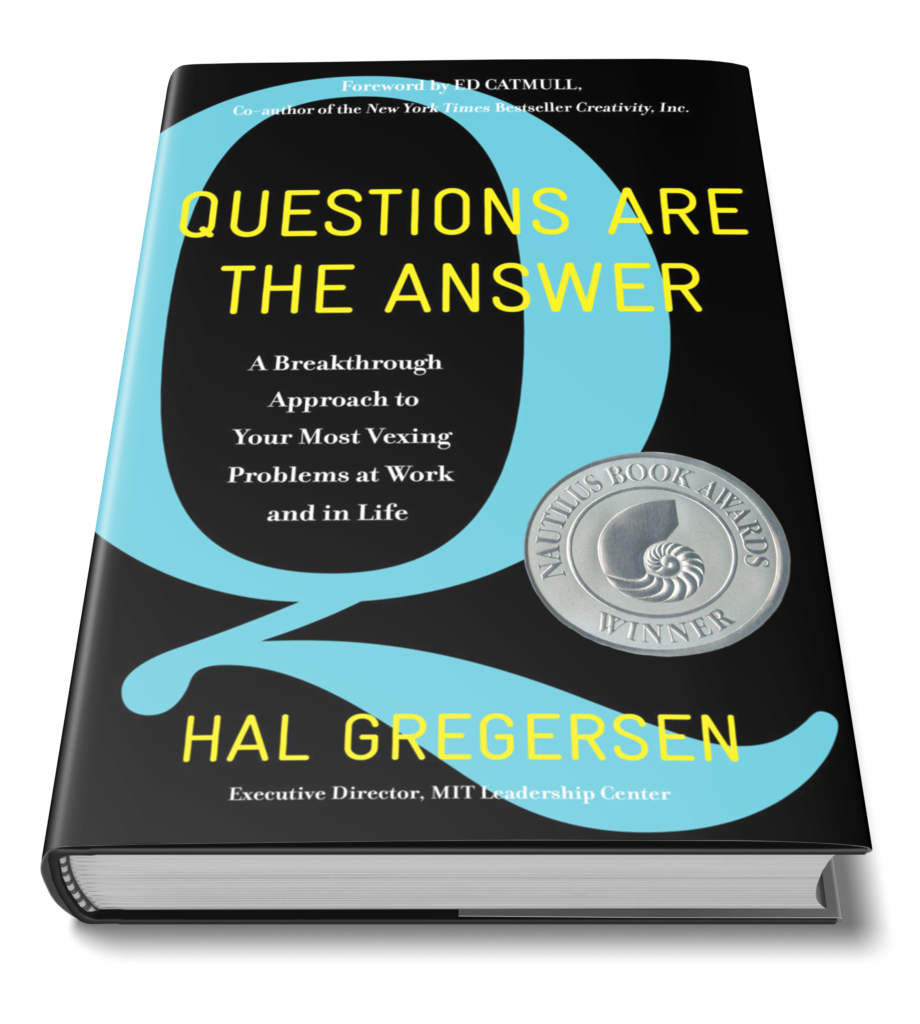
QAA covers a lot of ground, exploring how corporate leaders foster curiosity in themselves and by creating environments where their employees can feel not just safe, but encouraged, to ask tough questions. It relies a lot on inspiring anecdotes about famous business leaders. As a result, a lot of the takeaways need to be scaled down for those of us who aren’t the CEO of a massive company. One of the things that doesn’t need much downsizing is what Gregersen calls a Question Burst, which is quite similar to a QFT session.
We’ll look at both of those in more detail later. For now I’d like to focus on what they have in common.
Both QAA and QFT focus not so much on what the individual can do to be more curious, so much as the need for leaders to foster environments where questions are welcome and safe to ask, whether that’s an office or a classroom. It’s hard to motivate someone to ask more or better questions when the situation they are in fails to incentivize that, or actively punishes it.
With Questions, Less is Usually Less
Another point raised in QAA and QFT is that we don’t need to learn how to ask questions: We need to un-learn all the self-censoring we’ve mastered.
As any parent could tell you, children start off good at asking questions. Then our parents teach us, quite correctly, that not all questions are appropriate at all times. Then we go to schools, where we are judged more harshly on our questions. We are also introduced to the concept that there’s a lot of correlation between who asks the questions and who is in authority.
Finally, we end up in workplaces. The wrong question just went from getting you detention to getting you fired.
The result is that children go from asking hundreds of questions a day, to a handful, as they close in on adulthood.
That’s all pretty well researched per QFT and QAA. The following takeaway is not, but I’m still comfortable making the call: the odds of you self-censoring a good question into oblivion are probably a good deal higher than those of you having a stupid question. Unless you are asking questions with the unfiltered cadence of a toddler, you could probably stand to ask more questions.
Because worrying about the appropriateness and consequences of a question are already front and centre for most people, trying to get people to ask “better” questions could have a dramatic chilling effect. Imposing yet another internal checklist to apply to questions before sharing them could easily do more harm than good. The road to better questions goes through the land of asking more questions, seeing the impact the best of those questions have, and letting that influence how both individuals and the organization approach challenges.
For people to ask better questions, they have to start asking questions, and if they are going to feel safe asking meaningful questions, leaders need to make sure that is the environment they are building.
Getting Cozy with Curiosity
As mentioned earlier, a lot of QAA isn’t so much methods to apply as inspiring ideas to emulate. Plenty are good to go as is, but some wouldn’t really fly for people outside the C-suite of a very large company. Hiring a clown (literally) to come to board meetings and act as a court jester, poking fun at the leadership, isn’t exactly something a middle-manager makes happen.
Almost all of them, however, are about getting out of our comfort zone. The more we are exposed to new ideas, the more our mind is able to shift into a curious, exploring mode. That kind of thinking can atrophy the more we develop experience and specialization, making it harder for us to adapt.
Here are the things I am trying to apply, some taken as is, and some with scale adjustments for folks outside the C-Suite:
- Explore the World
This one starts out as “live abroad as much as you can” but that is a big ask. For us non-CEOs, I’m replacing it with travel that allows you to interact with locals in their own environment.
- Expose Yourself to Art
This one starts out as “make a community with live/work spaces for artists to experiment and create in, then immerse yourself in it.” We’re paring it back to “go see something at a gallery or theatre made by someone with a different viewpoint than you.”
- Talk to People Outside Your Normal Circles
This begins as an anecdote about a CEO getting a ride from the airport to the office from a delivery driver instead of waiting a few minutes for a delayed limo. The benefit wasn’t the time saving though: the CEO spent the ride talking to the driver about their job and interactions with the company. I don’t have a network of delivery trucks, but I do take a good deal of rideshares, and always try to converse with the drivers (if it’s obvious they aren’t the chatty type, I let it go).
- Meditate
This one works for Fortune 500 leaders like Marc Benioff all the way through to monks that have sworn vows of poverty. Put your mind in a different state from time to time, daily if you can manage it.
- Do Something You Don’t Already Know How to Do
Forcing yourself to be a beginner at something is a great way to build the perspective that there is always more to learn, that you don’t have all the answers, and that being honest about what you don’t know is often the fastest way to learn.
- Don’t Rush to Solutions
When we haven’t decided on a solution, it can be very uncomfortable. Thinking about a problem feels (and in most orgs, is seen as) a lot less productive than working on a solution. But accepting a solution rescopes the whole mental space we work in. Instead of asking “how do we improve xyz,” we are now asking “how do we apply abc to improve xyz.” Obviously, solutions do need to be found and applied, but try to get comfortable with the headspace that accompanies comparing solutions.
- Don’t Hype Solutions When You Want Honest Feedback
Don’t start a conversation with “I have been working really hard on using abc to fix xyz for several weeks now and I think there’s been a lot of progress” if you want honest feedback. Try “I am thinking about xyz and wondering how you might approach it?” Save the fact you actually have a solution in mind as a follow up question, and downplay your attachment to it.
While that helps me get on the path to asking more questions, these aren’t things that I can impose on my clients (as much as I’d love to take an afternoon off to visit an art gallery with them). Gregersen also shares a method he uses in his professional practice, called a Question Burst.
We’ll look at it in a moment, but I want to switch back to the Question Formulation Technique at this point, as the two are quite similar.
Question Formulation Technique
The most robust methodology I could find to get people asking more questions was QFT. QFT was developed by the Right Question Institute as part of community organizing work, and introduced to educators in the 2011 book Make Just One Change by co-founders Dan Rothstein and Luz Santana. Despite knowing it may have limited applicability in a business setting, I wanted some exposure to it.
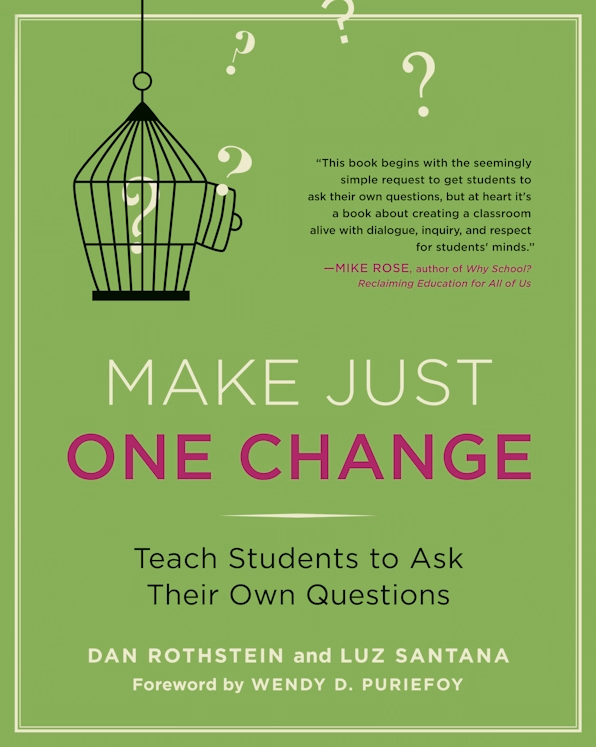
It was a great course about a great method. And one with applications well outside the classroom. Most of the people taking the course were educators with access to students: I had to use my girlfriend as my “class” for homework purposes.
Instead of basic geometry or the civil rights movement, we set a four minute timer, and she generated a list of questions about a trip we are planning. While our topic was frivolous compared to my classmates’, we went from our question list to having the whole trip planned in about 90 minutes, which is a record for us.
For any educational context, or personal or community-based endeavours, where a transparent exchange of thought would help, I’d consider rolling out a QFT session. But I wouldn’t use it in a business setting for two reasons. The simple one is the very generous CC licensing only extends to non-commercial use.
Beyond that, though, there’s no next step a client or boss would get excited about. An educator needs to reintegrate this with their lesson plan, answering questions or guiding students to find their own answers. It can get you closer to finding a solution in the sense that exploring a problem helps you solve it, but the goal of the technique is to get better at exploring topics, more than it is to arrive at a solution.
Question Formulation Technique Resources
The Right Question Institute – What is the QFT?
Question Burst
The Question Burst method, as mentioned above, is quite similar to the Question Formulation Technique. Both feature a timed interval where participants generate as many questions as possible, then engage in exercises to refine and prioritize their questions. The nature of those exercises and what happens with the prioritized questions is one area where things differ.
Another is that in QFT questions are based on a prompt, which is a sentence or two, a quote, or even something more abstract, like an image or piece of music. Question Burst instead allocates up to two minutes for the facilitator to provide information on the topic.
QFT is appropriately open-ended so that students can explore new ideas and educators can weave it into their teaching in appropriate ways. Question Burst’s extended context and included follow-up questions provide structure that leads to taking action, and setting a plan to continue using curiosity to move forward on a challenge, in the absence of an instructor.
Question Burst Resources
Question Burst Modifications for Discovery
The Question Burst method as presented in the above guide and described in QAA is an excellent method that I can recommend for any environment where people are already pretty comfortable with asking tough questions. I’ve used it in discovery contexts (for new projects with current clients) with some modifications: Specifically, I take the prioritized questions away, categorize them, and come back with some answers and ideas on how to move forward.
I’ve really enjoyed the results. I’m not going to get into my theories on why discovery can be hard on the people trying to explain what they need. I’ll just say that letting them ask the questions instead of having to answer mine cuts away a lot of the more stressful and performative aspects.
One thing that remains, in the Question Burst context and in pretty much every meeting, is that bosses tend to set the tone to an extent that often impacts the value of the activity negatively. And strangely, it has very little to do with the people in the room. If no one talks before the CEO at any meeting the CEO is in, that establishes the norm. People who have no problem cracking a friendly joke at their boss’s expense, or expressing their disagreement with that boss when necessary, can still be hesitant to speak before that boss does. Particularly in a new situation – like when a consultant is around.
Unattributed Question Bursts
The Question Burst as described in QAA involves participants throwing out questions while someone, usually the facilitator, acts as a scribe. One issue I’ve had with this is the scribe’s typing/writing speed often becoming a bottleneck. The bigger one is the issue above of people wanting to let senior colleagues go first, which anchors the rest of the session. Even where people are equal down to the pixel on the org chart, some people have more confidence or charisma than others. They might ask more questions, or people might be more hesitant to ask questions that run contrary to theirs.
My response was to try running Question Bursts where people write their questions down and prioritize them, then send them to me as private messages. This alleviates what I’ll understate as the “shyness” problems, even in groups small enough to make guessing who asked what somewhat obvious. Unfortunately, it means cross-pollination of ideas is either eliminated, or relies on some lightning-quick cutting and pasting by the facilitator, which becomes impossible for all but the smallest groups.
Hiding attribution, while fostering cross-pollination, and allowing the facilitator to manage the session smoothly, seemed like it might have a technical solution, so I built version 0.1. My next post will explain how it works, and I am planning to run a demo at MeasureCamp Toronto on Oct 3, 2026. Hopefully I will see you there!
Leave a Reply